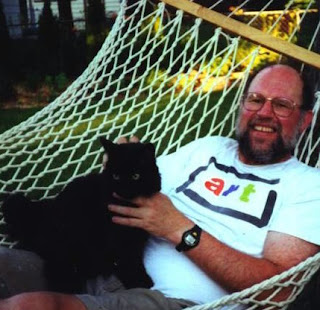
i think this poem speaks more eloquently about education than i ever could.
note : Alexis Rotella is now a famous poet.
Purple by Alexis Rotella
In the first grade Mrs. Lohr
said my purple teepee
wasn't realistic enough,
that purple was no color
for a tent,
that purple was a color
for people who died,
that my drawing wasn't
good enough
to hang with the others.
I walked back to my seat
counting the swish swish swishes
of my baggy corduroy trousers.
With a black crayon
night fall came
to my purple tent
in the middle
of an afternoon.
In second grade Mr. Barta
said draw anything;
he didn't care what.
I left my paper blank
and when he came around
to my desk
my heart beat like a tom tom.
He touched my head
with his big hand
and in a soft voice said
the snowfall
how clean and white and beautiful.
Saturday, November 22, 2008

Sunday, November 16, 2008
Wabi Sabi
Like Feng Shui, wabi sabi is an Eastern idea gaining popularity in the West. Unlike Feng Shui, wabi sabi is not a technique for increasing wealth, or tapping into some unseen mystical power. It is quite the opposite. It is an intuitive way of living that involves noticing the moments that make life rich and paying attention to the simple pleasures that can be over-shadowed by the bustle and excess of our consumer society.
It started with tea. In Japan, in the Middle Ages, nobles and military leaders strengthened political alliances by throwing elaborate tea parties in which expensive teapots and tea-making utensils were displayed and given as gifts. These ostentatious events focused on expensive Chinese art and tea objects and were the exclusive territory of the rich. Zen monks, who had brought tea to Japan in the first place, continued to develop a tea ceremony called wabi tea, which emphasized a different kind of wealth. Their ceremony used rustic Japanese pottery and focused on the natural elements used in making tea. It allowed participants to connect with the pleasure of drinking tea and provided a tranquil space in which to appreciate natural beauty.
The tea masters who preformed these ceremonies situated their tea huts in the middle of gardens and crafted their ceremonies to be rich in symbolic meaning. They practiced making tea until they could do it without thinking about it. Then, when they served tea to others, they were free to focus their attention entirely on their guests without being distracted by the preparation process. The most famous tea master was Sen no Rikyu who took wabi tea to a new level of subtlety thanks to the patronage of the Shogun Oda Nobunaga. Nobunaga used both forms of tea ceremony to unify Japan. Three of Rikyu's principle students were devout Christians: Furuta Oribe, Takayama Ukon, and Gamou Ujisato. They discovered that the way of tea enriched their own faith because it provided a concrete example of selfless attention to others. By learning to serve so well that you no longer need to think about what you are doing, you are free to focus on your guests.
Sabi is a word that originated in Japanese poetry. It expresses the feeling you get in the autumn when the geese are flying south and the leaves are falling. It is a sort of somber longing that is felt in the muted colors and earthy aroma of a forest preparing for winter. This melancholy ache is a sort of hopeful sadness that recognizes that nothing is perfect, nothing lasts, and nothing is finished, but that even so, life is full of meaning. The complete term 'wabi sabi' describes a way of life practiced by those who notice and appreciate the significant moments of each day, live fully in each change of season, and connect with nature and those around them in meaningful and gentle ways.(This article first appeared in the Nanaimo Daily News - Saturday, January 24, 2004.)
Here are some examples of wabi sabi in haiku :
the morning’s snow
I can chew dried salmon
alone
xxxxxxxxx- Basho
drifting snow
lambs inside the barn
inside the ewes
xxxxxxxxx-Harriot West
rumors of war
up into a darkening sky
— a child's newsprint kite
xxxx- Angelee Deodhar
the tom asleep
on the widow's porch
is losing his sun
xxxx- William Hart
Thursday, October 23, 2008
lovesickness
Evidently based on the spam i receive there is a rash of male love sickness going around ever since Sarah Palin came on the scene. However thanks to the
compassionate drug companies we do not have to suffer:
New study declares Love a disease; medication may be available
Doctors from the University of Allopath have announced that Love is a curable disease. It is characterized by abnormal heart rhythms, sweating, impaired brain function, incoherent speech patterns and loss of sleep, among other signs. Thanks to this pioneering work from researchers sponsored by the leading drug firm Pferck, researchers have learned that love is a common biochemical disorder affecting both men and women of all ages.
Fortunately, it is treatable with prescription drugs. A new drug, Miserexa, combines beta blockers and antidepressants to alleviate the symptoms of Love. This drug slows the heart and helps patients feel detached from reality, counteracting the unhealthy neediness of Love.
The Food and Drug Administration (FDA) approved the new drug this week. In a press conference, chief FDA drug approval scientist Dr. B. Fuddle said, "We are declaring war on Love, and doing everything in our power to eradicate Love from the world."
The market for Miserexa is expected to reach six billion dollars annually. "Love has reached epidemic proportions", explained a public relations representative of Pferk. "If we do not act immediately to thwart the spread of this disease, Love will run rampant, and we will be facing an epidemic of Love in the world."
Health researchers first became aware of the disease after being alerted to symptoms of Love by the psychiatry community, which has been instrumental in the detection and aggressive treatment of this dangerous condition with brain-altering drugs. "We were seeing it in an alarming number of patients", explained one psychiatrist, "and it was causing untold suffering in their lives. Fortunately, the condition can now be chemically corrected."
Further study revealed that Love is highly contagious. It can apparently spread from one person to another, although the mechanism of transmission is currently unknown. Love also spreads easily from mother to child, especially in newborns. Interestingly, Love has no effect on landlords and corporate CEOs, who seem to possess some unknown immunity to the disease.
Given the expanding threat of this disease, doctors stress it is important that all adults get screened for Love as soon as possible. Hospitals and clinics are now setting up Love screening programs in the hopes of catching the disease early and treating it aggressively with targeted pharmaceuticals. "Nearly half the population may now be suffering from Love", said Dr. Fuddle, "and we estimate more than 90% of the carriers are currently going without treatment. It is important that we provide screenings and treatment on a population-wide basis."
If Love is not detected and treated in its early stages, it can advance to the point where the only solution is surgery. In such severe cases of Love, skilled surgeons perform a cardiectomy (a surgical removal of the heart). The procedure is risky, and many patients have died on the operating table, but many more have been successfully saved from the ravages of Love by the skillful blade of a compassionate surgeon.
The American Misery Association (AMA), whose mission is to find the cure for Love, is working hard to help educate the general public to watch for early signs of Love. People are urged to conduct a Love self-examination in the privacy of their own homes, and to watch out for the classic symptoms of Love: racing pulse, sweaty palms, inability to speak in coherent sentences, or confusion around certain attractive individuals. People are also taught how to avoid giving Love to others - an important step in halting the spread of this disease.
If you suspect that you or someone you know might be suffering from Love, don't wait. Treatment is available. Don't let Loved ones suffer any longer.
This press release is brought to you by Pferck, where today's rip-off drug prices fund tomorrow's profit miracles.
Friday, September 5, 2008
napping
I read a lot of poetry, mostly on the Writers Almanac and Poetry Daily. Once in awhile I find a poem that really hits home :
Afternoon Nap
for Stuart and Ali
The dishes washed, the plates stacked
Neatly in their cupboards, he scooped up a section
Of the Sunday paper and slipped into the lounge,
His belt stretched around a second slice of cake.
He dozed off over the picture of a scoring hero
And came to again at four, the house quiet,
And brightness gone from the sky. He felt weak,
Knowing that this day was done, or wasted,
And thought about his school, how they
Used to run for miles around a grass track
And never get tired. He thought of friends
Who had fallen into ambition, success
And failure. He should have written letters
But didn't. What was it that he had wanted,
Running around that circle? What would
He now say he had missed? Nothing. He felt
That day's paper slip from his hands,
His muscles loosen, and lids close over eyes
That still stared into the near-dark garden
Where small birds flitted about unnoticed.
James W. Wood
Southwest Review
Volume 93, Number 2 / 2008
James W. Wood
James W. Wood is the author of two short collections, Swingtime and The Theory of Everything. He reviews regularly for Scotland on Sunday and lives in Edinburgh. Poems, articles, and reviews have also appeared in The Times Literary Supplement, The Daily Telegraph, Poetry Review, The London Magazine, and many others. "Afternoon Nap" is included in a chapbook, Inextinguishable, published by Knucker Press.
Thursday, July 31, 2008
What I Learned in High School
what i learned in high school
i was impelled to reminisce about my high school years upon hearing on NPR that todays high school curriculum's were so diverse across the nation
that it was difficult to devise a test to fairly measure the knowledge of potential college applicants. the story went on to say that until the counter culture flourished in the late 60's and early 70's what was taught was very similar across the nation. i guess the black power, women liberation, cultural relativism and the peace movements forever altered the landscape of high school studies.
consequently i came up with the idea of creating a cd compilation of music i listened to and excerpts of books that influenced me during my high school years(1962-1965).
included are cultural influences both inside and outside of school from church to tv and the movies.
the playlist:
1 charles dickens - it was the best of times(A Tale of Two Cities) : 58
2. The Beatles -- Yesterday (2 05)
3. mark twain -- jim bakers blue jay yarn (1.27}
4. Sha Na Na -- The Birds and the Bees (2:10)
5. john howard griffin - black like me (1:28)
6. Bob Dylan -- Blowin' in the Wind (2:49)
7. mark twain -- huck finn (:37)
8. harper lee -- to kill a mockingbird (3:10)
9. Paul Robeson -- Ol Man River (4:19)
10. robert frost - stopping by the woods (:58)
11 Gerry & The Pacemakers - Ferry Cross The Mersey (2:25)
12 shakesphere -- caesar eulogy (2:30)
13. The Mamas & the Papas -- California Dreamin' (2:40)
14. mary chase - harvey (3:31)
15 Petula Clark - Downtown (3:05)
16 Judy Collins - Amazing Grace (4:07)
17. st. matthew - sermon on the mount (2:09)
18. The Lettermen --1 Believe (2:11)
19. victor hugo --les miserables (2:17)
20. Shirley Jones -- You'll Never Walk Alone [From Carousel] (1:45)
21. edward fizgerald - rubaiyat of omar khayyam (1:44)
22. The Beatles -- Michelle (2:42)
23. The Beatles - Can't Buy Me Love (2:12)
24. george eliot -- silas marner (1:43)
25. Jackie DeShannon - What The World Needs Now Is Love 3:08
26. Barbara Lewis - Baby I'm Yours (2:33)
27. Barbara Cook - Till There Was You [From The Music Man] i2 4cigh
28. The Rolling Stones -- (I Can't Get No) Satisfaction (3:44)
29. shakesphere -- hamlet soliloquy (2:14)
30. Peter & Gordon - A World Without Love (2.40)
31. leo tolstoy - war and peace (1:30)
32 Barry McGuire -- Eve of Destruction (3:36)
Several of the books were assigned readings and some were mentioned in classes but many were discovered by unfettered curiosity outside the confines of
the school. Most of the music was heard on top-forty radio or on albums. I was especially fond of a record by the Lettermen of show tunes. Though musically
inept I was sometimes allowed to sing in the church choir at Parkview Baptist Church where I learned many hymns. My favorite being Amazing Grace. My senior
year my class did a performance of The Music Man by which I was amazed. It made a lasting impression.
Though I entitled the compilation What I Learned in High school it's not so much what i learned but what i experienced and had a lasting educational effect.
Its what was thrown up against the blank canvas of my mind and stuck like the splashed hues of a jackson pollock painting. A fragmented abstraction of memories
in a quilted undecipherable pattern.
In the 9th grade I remember reading Hamlet in Mr. Hadley's English class and the challenge of struggling to make sense of the weird words and then
the feeling of satisfaction in understanding and enjoying the rich language. In the summer after my sophomore year i read To Kill a Mockingbird as i laid
in bed with bronchitis coughing my way thru the pages emotionally engrossed. It was in high school i developed a love of film. Largely due to TV and
Saturday Night at the Movies where I was exhilarated to watch War and Peace with Henry Fonda as Pierre. It inspired me to read thre book my senior year.
There was also The Vikings with Tony Curtis and Kirk Douglas, Spartacus, and the Mountain with Spencer Tracy. There was of course the Beatles. my younger
sisters played their music continually after they were on the Ed Sullivan show in 1964. (which we watched every Sunday night).
There are many moments that I cringe to remember. It was four short years long ago, four years largely wasted during which I abandoned any dreams of
fame or fortune and all ambition to be anyone special. It was then I realized that I was just your average bloke. With a bit of torment i reluctantly accepted my
fate to be unique just like everybody else. That's just the way life is i learned. That's the way the snowflakes fall, that the way the cookies crumble.
I suspect that your compilation would be much different than mine even if you were my classmate but if you are so inclined and make one I'd love to see it.
If you would like a copy of my cd let me know- Normally its $99.99 but if you call now you can get the entire cd for only $9.99 (only 999 1 penny payments)
but wait... theres more....
Thursday, May 1, 2008
reading
The question i asked last month regarding "do you read fiction or non-fiction" didn't
seem to generate much response. Of the 4 responses i did get 2 said they try for a
balance and 2 said they prefer nonfiction. i seem to prefer fiction in that last year i read 21 fiction and 8 nonfiction books. i found a couple of interesting polls on the internet that reading is not dead. the following is from a Harris poll:
"For years, people have been crying about the death of the book. While reading books may be declining, Americans are reading. Just one in ten (9%) say they typically read no books in an average year. About one-quarter (23%) read between 1 and 3 books, while one in five (19%) read between 4 and 6 books and 13 percent typically read between 7 and 10 books. And, over one-third (37%) of Americans say they read more then ten books in an average year.
There are certain groups who are more likely to read more than ten books in an average year. Looking at the generations, almost half (47%) of Matures (those aged 63 and older) say they read more than ten books compared to just one-third (33%) of Baby Boomers (those aged 44-62). Women are also more likely to read more than men – 44 percent of women read more than ten books a year compared to three in ten (29%) men. Candidates may not want to try books to reach their partisans, but they may be a good way to reach out to Independents"
a zogby poll examines whether what you like to read predicts your politics :
* Conservatives and liberals are more likely than moderates to read books.
* Liberals are almost twice as likely as conservatives to read
literary fiction (20% to 11%) and they're also more likely to read
science fiction/fantasy than moderates (13% to 8%).
* Moderates and conservatives favor mysteries and thrillers while
liberals (22%) and conservatives (20%) prefer books about politics and
current events.
* Liberals like non-fiction and fiction equally. Moderates and
conservatives prefer non-fiction.
* Moderates are more likely to read self-help books (7%) –
liberals are the least likely to read them (3%).
of course everyone i know falls outside any polling parameters.
Here is a list of the books i read in the past year:
FICTION
Blood Lure Nevada Barr
Skeleton Man tony Hillerman
Mission Song John Le Carre
One Good Turn Kate Atkinson
Arthur and George Julian Barnes
the Road Cormac McCarthy
Brooklyn Follies Paul Auster
What is What Dave Eggers
Echomaker Richard Powers
American Outrage Tim Green
HouseKeeping Maryanne Robinson
No Country for Old Men Cormac McCarthy
Bridge of Sighs Richard Russo
The Book Thief Markus Zusak
A Thousand Slendid Suns Khaled Hosseini
The Reluctant Fundamentalist Mohsin Hamid
The Appeal John Grisham
A Soldier of the Great War Mark Helprin
A Free Life Ha Jin
The Yiddish Policeman's Union Michael Chabon
Everyman Philip Roth
NONFICTION
The God Delusion Richard Dawkins
Into the Wild Jon Krakauer
Clapton Eric Clapton
The Beatles Bob Spitz
MoneyBall Michael Lewis
Truth and Beauty Ann Pacthett
Heart Breaking Work of Staggering Genius Dave Eggers
Wednesday, April 9, 2008
a question for readers
i recently read a review of a book of poems by laura kamasischke whose poems are
described as confessionally autobiographical like sylvia plath and robert lowell's
poems were in the 60's. the reviewer asks what should we read? who do we turn to
to help us understand our life? is it the fiction or non-fiction writer (or the poet). one writer has said that its experience we learn most from and that the fiction writer can create a story of internal and external events we can vicariously experience. and because "experience resists explanation" fiction comes closer to
the truth than non-fiction. who do you trust? the novelist or the journalist.
we might of turned to the poets in th 60's and 70's but in recent years its the memoirs that are getting the readers. there have been a couple of blantant examples
of memoirs full of lies as this quote points out (both highly touted by oprah before they were exposed as lies) :
"When James Frey approached publishers marketing his manuscript of “A Million Little Pieces” as fiction, none were interested. When he labeled it “memoir” Random House jumped.
Margaret Seltzer's excuse was that she really wanted to tell the stories of the life her gang-member ffriends lived, and she believed that they had a greater chance of being heard if she wrote them as her own story.
Seltzer and Frey both sold memoirs because that's what the publishers wanted. And the publishers wanted memoirs because readers crave them. Non-fiction books sell. Readers want the intimacy of a memoir and the sense of being allowed into another person's world – especially if that person has had a dramatic and harrowing life.
The process of memoir writing is fraught with the possibility of factual inaccuracy, being dependent as it is on memory and recollection. It is nearly impossible to guarantee that every detail of a creative non-fiction story is unquestionably accurate.
Still, readers are right to assume that memoirs are true, or at least as true as memory will allow."
(In her supposed memoir “Love and Consequences” (Riverhead Books, 2008), Margaret A. Jones writes about her life as a half-Native American, half-white girl growing up in a foster home in South Central Los Angeles. She describes her experiences as a drug-dealing gang member in L.A. watching friends and family die in gang violence.)
so my question to you is : what do you prefer fiction or non-fiction?
Kitchen Song by Laura Kasischke
The white bowls in the orderly
cupboards filled with nothing.
The sound
of applause in running water.
All those who've drowned in oceans, all
who've drowned in pools, in ponds, the small
family together in the car hit head on. The pantry
full of lilies, the lobsters scratching to get out of the pot, and God
being pulled across the heavens
in a burning car.
The recipes
like confessions.
The confessions like songs.
The sun. The bomb. The white
bowls in the orderly
cupboards filled with blood. I wanted
something simple, and domestic. A kitchen song.
They were just driving along. Dad
turned the radio off, and Mom
turned it back on.
Subscribe to:
Posts (Atom)